Skip to content
Trail & Terminal

01 — Camp / Roundup

Best camping gear under $50

The bracket where cheap and good overlap almost completely -- and the two categories where fifty dollars still does not buy a real answer.

By Brijon M.Last updated How we pick
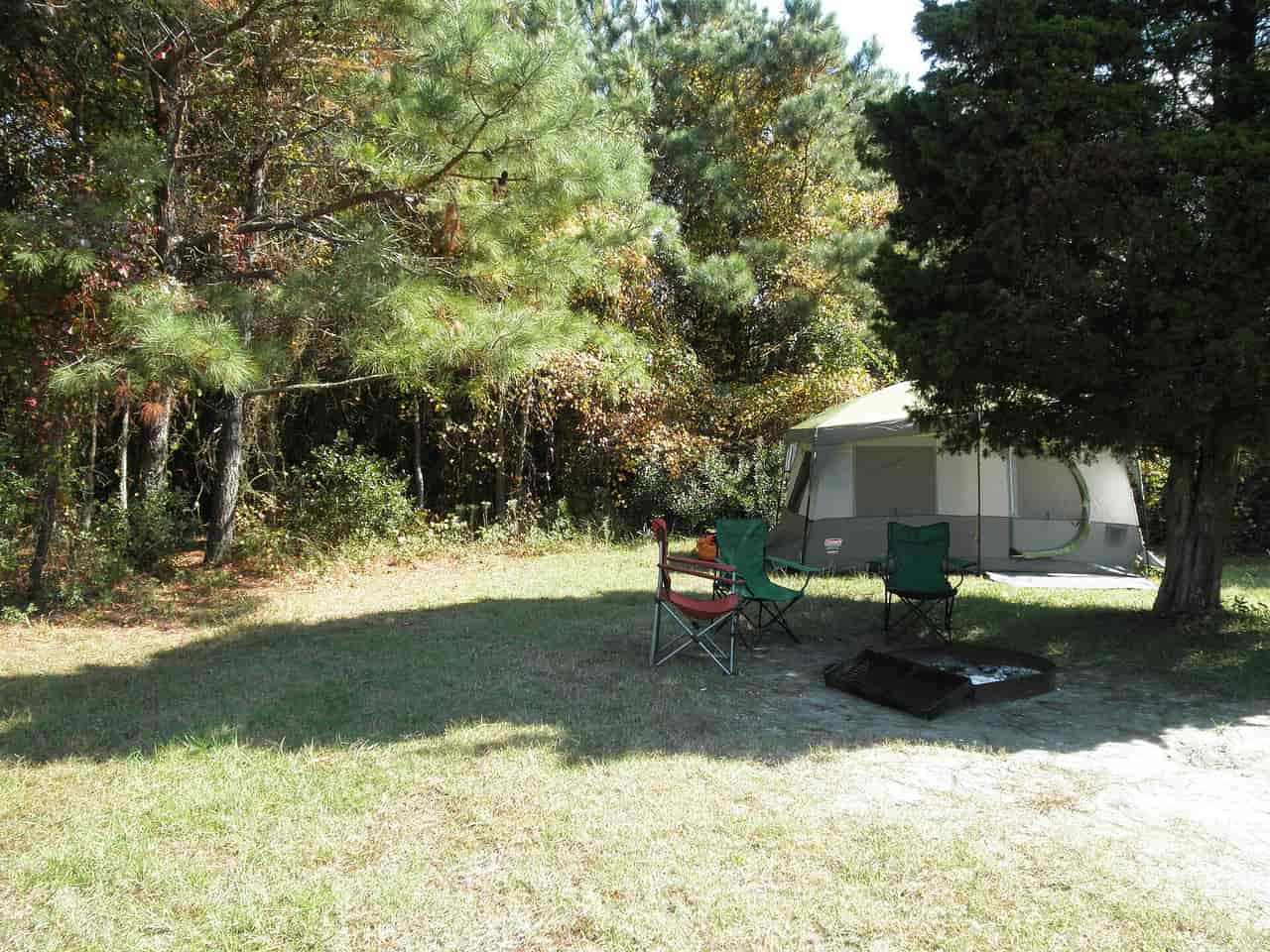
A campsite with a tent, folding chairs and a fire ring under trees

The short answer

Under fifty dollars buys the best version of several camping categories outright: a headlamp, a lantern, a water filter, a hard-anodized skillet, a folding knife and a dry bag. It does not reliably buy a tent or a sleeping bag. Spend the budget where it buys the top of the category.

Trail & Terminal earns a commission when you buy through our Amazon links, at no extra cost to you. It does not change which products we pick -- see our affiliate disclosure and selection method.

Our picks at a glance

Best camping gear under $50 -- ranked picks
#ProductBest forKey specPrice
1Petzl Tikkina HeadlampA plain, reliable headlamp from a company that makes climbing hardware. In this bracket it is not a compromise version of anything.the single best use of this budgetAAA or rechargeable core
2Black Diamond Moji LanternA fist-sized lantern that hangs from a tent loop and makes the inside of a tent usable instead of merely lit.light you can sit aroundAAA, double hook hang
3Sawyer MINI Water Filtration SystemA hollow-fiber filter the size of a thumb that handles the realistic campsite problem: a tap you do not trust, not a wilderness spring.water, with no running cost0.1 micron hollow fiber
4Nalgene Wide Mouth 32 oz BottleA single-wall copolyester bottle with a mouth wide enough for ice, a filter thread and a scrub brush.the bottle you stop replacing32 oz, 63 mm wide mouth
5Stanley Adventure Camp Cook SetA stainless pot with a vented lid and two nesting cups. The whole thing stores inside itself and survives a decade of abuse.one pot, two cups, no fuss24 oz pot, nests to one unit
6Lodge 10.25-Inch Cast Iron SkilletPre-seasoned cast iron that does not care about flame temperature, coals, or being left out overnight.cooking over an actual fire10.25 in, pre-seasoned
7Opinel No. 8 Folding KnifeA beechwood-handled folder with a locking collar. Unchanged design, genuinely sharp, and cheap enough to keep one in the camp bin permanently.a knife you will not resent losing8.5 cm blade, Virobloc lock
8Klymit Static V Sleeping PadAn inflatable pad with V-shaped chambers that sits at the ceiling of the under-fifty band and comfortably outperforms foam.the top of this bracketInflatable, V-chamber baffles
9Therm-a-Rest Compressible PillowShredded foam in a brushed polyester cover. Not an inflatable, which is exactly the point.actually sleeping, not just lying downShredded foam fill
10Sea to Summit Ultra-Sil Dry SackA featherweight roll-top sack that keeps one set of dry clothes dry no matter what the rest of the trip does.the thing you did not know you neededSiliconized nylon, roll-top

Ranked by the criteria in how we pick. We hold no live prices, so every button goes straight to the current Amazon listing.

Every pick, in full

The picks

1

Best for the single best use of this budget

Petzl Tikkina Headlamp

A plain, reliable headlamp from a company that makes climbing hardware. In this bracket it is not a compromise version of anything.

The most-used piece of camping equipment is the one that lets you do anything after sunset, and this is the category where a small budget buys the genuinely good version rather than a stripped-down one. The Tikkina is the plainest headlamp Petzl makes and it does the job the way a light switch does the job.

The honest limitation is the beam. It is a flood, which is right for cooking, finding a stuff sack and walking to the toilet block, and wrong for picking a line across a boulder field. If you want a red mode and a regulated beam that holds brightness as the batteries drain, that is the next step up and it is covered in our <a href="/camp/best-headlamps">headlamp roundup</a>. For a weekend at a campsite, the step up is optional.

Specs

  • Runs on three AAA batteries, or Petzl's rechargeable Core cell
  • Manufacturer-stated 300 lumens on the current model
  • Single-button interface, three white levels
  • Washable headband

Good for

  • One button, three levels -- nothing to learn in the dark with cold hands
  • Takes AAA cells you can buy at any gas station, which matters more on a trip than charge cycles
  • Light enough that it stays on your head instead of in a pocket

Bad at

  • No red mode on the base Tikkina -- you will wake the tent
  • No regulated output, so brightness tapers as the cells drain rather than holding steady
  • Flood beam only; it does not throw far enough to scout a trail junction at distance
2

Best for light you can sit around

Black Diamond Moji Lantern

A fist-sized lantern that hangs from a tent loop and makes the inside of a tent usable instead of merely lit.

A headlamp points where you look, which is exactly wrong when four people are sitting in a circle. A small lantern is the cheapest fix for that and the Moji is the one that gets bought most often because it is the right size: it hangs off a tent ceiling loop, it does not need its own stuff sack, and the frosted globe means nobody is staring into an LED.

The dimming dial is the feature worth paying for, because camping light has two jobs -- finding things, and not waking anybody -- and a lantern with fixed levels does one of them badly. Pair it with the headlamp above rather than instead of it. If you want something that also charges a phone, that is a different and more expensive category; see <a href="/camp/best-camping-lanterns">camping lanterns</a> and <a href="/camp/best-portable-power-banks-for-camping">power banks for camping</a>.

Specs

  • Three AAA batteries
  • Frosted globe for diffused, non-glare light
  • Dimming dial rather than fixed steps
  • Double-hook hang loop

Good for

  • Diffused light rather than a point source, which is the entire difference between a lantern and a flashlight pointed at the ceiling
  • The dimmer makes it usable as a nightlight for children at full dark
  • Small enough that nobody argues about packing it

Bad at

  • Not bright enough to light a picnic table for four people cooking
  • The hang loop is short -- you will want a spare bit of cord for taller tents
  • Runtime at full brightness is modest, so it wants fresh cells before a trip rather than after
3

Best for water, with no running cost

Sawyer MINI Water Filtration System

A hollow-fiber filter the size of a thumb that handles the realistic campsite problem: a tap you do not trust, not a wilderness spring.

Water is the category where the under-fifty version is not a lesser product, it is the same technology in a smaller housing. The MINI uses the same hollow-fiber membrane as Sawyer's larger filters; what you give up is flow rate, not filtration.

The freeze warning is the one that catches people, and it is worth repeating because the failure is silent: a filter that froze with water in it will still pass water, it just will not filter it. Keep it inside the car or inside a sleeping bag on a cold night. If you want faster flow for a group, the full-size Sawyer Squeeze sits at the very top of this bracket and our <a href="/trail/best-water-filters-for-backpacking">water filter roundup</a> covers the step up and the gravity options.

Specs

  • 0.1 micron absolute hollow-fiber membrane
  • Threads onto standard disposable bottles and the included pouch
  • Backflush syringe included
  • Manufacturer-rated for a very high lifetime volume with backflushing

Good for

  • No batteries, no chemicals, no waiting -- you drink while you squeeze
  • Small and light enough to live in a glovebox or a daypack permanently
  • Field-maintainable: a clogged filter is a backflush, not a replacement

Bad at

  • Slow. The flow rate is the price of the small size, and it gets slower as the membrane loads
  • Does not remove viruses or dissolved chemicals -- it is a bacteria and protozoa filter
  • Must not freeze. A frozen membrane cracks invisibly and keeps filtering nothing
4

Best for the bottle you stop replacing

Nalgene Wide Mouth 32 oz Bottle

A single-wall copolyester bottle with a mouth wide enough for ice, a filter thread and a scrub brush.

Insulated steel bottles are the default recommendation everywhere and they are the wrong first purchase at this budget. A single-wall Nalgene costs a fraction as much, weighs less, shows you its contents, survives being dropped on rock, and threads directly onto the filter above.

The trade is real and we will not soften it: your water will be whatever temperature the day is. If that matters more to you than the price and the wide mouth, the insulated category is a different purchase and <a href="/trail/hydro-flask-vs-yeti-vs-stanley">Hydro Flask vs YETI vs Stanley</a> compares the three bottles people actually choose between. For a campsite, where a cooler is sitting ten feet away, insulation in the bottle is a luxury.

Specs

  • 32 fl oz capacity with molded volume markings
  • 63 mm wide mouth that accepts most filter threads
  • Tethered lid
  • Dishwasher safe

Good for

  • The wide mouth takes ice cubes, powdered drink mix and a bottle brush -- the three things a narrow neck refuses
  • Transparent, so you can see how much is left and whether it is clean
  • Effectively unbreakable, and the lid is tethered so it cannot roll under the car

Bad at

  • No insulation at all -- hot days make hot water and cold nights make cold water
  • Bulky in a side pocket compared with a soft flask
  • Sweats in heat, which will dampen anything packed against it
5

Best for one pot, two cups, no fuss

Stanley Adventure Camp Cook Set

A stainless pot with a vented lid and two nesting cups. The whole thing stores inside itself and survives a decade of abuse.

Cookware is the most over-bought category in camping. Full nesting kitchen sets look organized in the box and then live in a garage, because what a trip actually needs is one pot that boils water and two things to drink from.

Stainless is the right material at this price. The nonstick coatings that appear on cheap camp cookware are the first thing to fail -- they are scratched by the metal utensils everybody actually brings and then they shed. Stainless scorches more easily, which is a technique problem, not a durability problem. For bigger groups and for the sets that are genuinely worth the upgrade, see <a href="/camp/best-camping-cookware">camping cookware</a>.

Specs

  • 24 oz stainless steel pot
  • Vented locking lid
  • Two insulated nesting cups
  • Folding handle; everything packs inside the pot

Good for

  • Stainless rather than coated, so metal utensils and scouring are fine
  • Nests into a single rattle-free unit, which is why it actually gets packed
  • The vented lid means you can strain pasta without a second item

Bad at

  • Stainless heats unevenly and scorches sauces where aluminum would not
  • 24 oz is one or two servings; it does not scale to a family dinner
  • The folding handle gets hot and needs a cloth
6

Best for cooking over an actual fire

Lodge 10.25-Inch Cast Iron Skillet

Pre-seasoned cast iron that does not care about flame temperature, coals, or being left out overnight.

A campsite is the one place where cast iron's drawbacks mostly disappear. Weight does not matter when the pan travels in a trunk, and uneven camp-stove burners and open fires are exactly the conditions cast iron handles better than thin aluminum does.

The care story is simpler than the internet suggests: cook in it, wipe it out, dry it on the heat for a minute, wipe a trace of oil over it. Soap is fine; standing water is not. The one real mistake is packing it damp into a plastic bin for a month, which is how a skillet comes out of storage orange. If your camping is mostly backpacking rather than car camping, skip this pick entirely.

Specs

  • 10.25 inch cooking surface, pre-seasoned from the factory
  • Cast iron throughout, including the handle
  • Two pour spouts
  • Oven, fire and grill safe with no temperature ceiling

Good for

  • The only common cookware that is happy sitting directly in coals
  • Holds heat, so it keeps cooking when a gust drops the stove flame
  • Improves with use and will outlive everything else in the bin

Bad at

  • Heavy. This is a car-camping item and nothing else
  • Rusts if packed damp -- it has to be dried on the heat before it goes away
  • The handle is cast iron too, so it is always hot and always needs a cloth
7

Best for a knife you will not resent losing

Opinel No. 8 Folding Knife

A beechwood-handled folder with a locking collar. Unchanged design, genuinely sharp, and cheap enough to keep one in the camp bin permanently.

Camping does not need a survival knife. It needs something that cuts cheese, opens packaging, trims cord and takes the point off a tent peg. The Opinel has been the honest answer to that for over a century and the price has not caught up with the reputation.

Choose carbon or stainless deliberately. Carbon takes a keener edge and will develop a gray patina and spot with rust if it goes away wet. Stainless asks nothing of you and gives up a little edge retention. For a knife that lives in a damp camp bin between trips, stainless is the sane choice. The swelling-handle problem is real on both: if it sticks, let it dry rather than forcing it.

Specs

  • 8.5 cm blade, in stainless or carbon steel
  • Virobloc twist collar locks the blade open and closed
  • Beechwood handle
  • Made in France

Good for

  • Takes and holds a working edge, which most knives in this bracket do not
  • The collar locks it shut as well as open -- it will not open itself in a bag
  • Flat and light enough to live in a pocket rather than a sheath

Bad at

  • The wooden handle swells when wet and the blade can stick shut until it dries
  • No pocket clip and no one-handed opening
  • Carbon steel version stains and spots unless it is dried; the stainless version holds an edge slightly less well
8

Best for the top of this bracket

Klymit Static V Sleeping Pad

An inflatable pad with V-shaped chambers that sits at the ceiling of the under-fifty band and comfortably outperforms foam.

Sleep is the category where camping budgets are most often misallocated. People buy a bigger tent and then lie on the ground inside it. A pad changes whether the trip was pleasant in a way that very little else does.

This pad sits right at the top of the bracket and sometimes just over it, which is worth knowing before you click. The specific limit is warmth, not comfort: it has little insulation, so on cold ground you will feel the cold through it even though the loft is fine. For shoulder-season or winter camping, the insulated pads in <a href="/camp/best-sleeping-pads">sleeping pads</a> are the honest recommendation, and <a href="/camp/sleeping-pad-vs-air-mattress">sleeping pad vs air mattress</a> covers the car-camping alternative.

Specs

  • Body-mapped V-chamber design to limit air movement
  • Manufacturer-stated 2.5 inch loft
  • Packs to roughly water-bottle size
  • Patch kit included

Good for

  • A genuine inflatable at a price where most options are foam
  • Packs far smaller than a closed-cell foam mat, which is the real constraint in a loaded car
  • The V-chambers limit the bounce you get from a plain tube pad

Bad at

  • Minimal insulation value -- this is a three-season pad and cold ground will come through it
  • Takes real lung effort to inflate; there is no pump bag
  • Punctures. Foam cannot fail this way and an inflatable always can
9

Best for actually sleeping, not just lying down

Therm-a-Rest Compressible Pillow

Shredded foam in a brushed polyester cover. Not an inflatable, which is exactly the point.

A rolled-up fleece works and everybody knows it, which is why this is the easiest pick on the list to skip and the one people most often regret skipping. A fleece unrolls during the night, has no loft, and is usually the garment you wanted to be wearing.

The reason to choose foam over an inflatable at this price is the feel. Inflatable camp pillows are lighter and pack smaller, and most people find them slippery and over-firm regardless of how carefully they are inflated. Foam is heavier and bulkier and simply works. On a car-camping trip, where bulk is free, that trade is not close.

Specs

  • Shredded urethane foam fill
  • Brushed polyester cover
  • Compresses into its own attached stuff pocket
  • Several sizes

Good for

  • Feels like a pillow rather than a balloon, which is the complaint that kills inflatable camp pillows
  • Nothing to puncture and nothing to inflate at the end of a long day
  • Machine washable, which matters more than it sounds after a season

Bad at

  • Bulky packed -- it compresses but it does not disappear the way an inflatable does
  • Heavier than an inflatable for the same head height
  • The foam settles over time and the pillow slowly gets thinner
10

Best for the thing you did not know you needed

Sea to Summit Ultra-Sil Dry Sack

A featherweight roll-top sack that keeps one set of dry clothes dry no matter what the rest of the trip does.

One sack with a change of clothes and a dry base layer in it is the cheapest insurance in camping. Tents leak, coolers sweat, car trunks get rained into while being loaded, and the difference between a miserable evening and a fine one is often a dry fleece.

The cross-trip usefulness is the reason it is on this list rather than a plastic bag. The same sack organizes a carry-on, keeps electronics dry in a canoe, and compresses a jacket. If your use case is genuinely wet -- rafting, sea kayaking, anything where the bag goes in the water rather than near it -- you want a heavier welded roll-top instead, and <a href="/trail/best-dry-bags">dry bags</a> covers that distinction properly.

Specs

  • Siliconized Cordura nylon
  • Roll-top closure with a side-release buckle
  • Several capacities
  • Packs down to roughly the size of its own buckle

Good for

  • Weighs and costs almost nothing, and solves a problem that ruins trips
  • Doubles as compression for a down jacket or a sleeping bag liner
  • Equally useful on a kayak, in a carry-on, and in a leaking trunk

Bad at

  • Water-resistant rather than submersible -- it is not a diving bag
  • The thin fabric is light for a reason and it will abrade if dragged over rock
  • Roll-tops only seal if you actually roll them three times, which people do not

01 — Selection criteria

How we chose what belongs in this bracket

A budget roundup fails in one specific way: it lists the cheapest item in every category and calls the result a kit. That produces a pile of things that each half-work. We went the other way and asked which categories the under-fifty band can cover completely.

There are more of them than you would expect. Light, water treatment, a knife, a pot, a skillet and a dry bag are all categories where the best answer for a camping trip costs well under fifty dollars and the expensive versions buy convenience rather than capability. There are also two categories where it does not work, and we have said so below rather than padding the list.

  • Is this the top of its category, or the bottom? A headlamp under fifty dollars is a genuinely good headlamp. A tent under fifty dollars is a genuinely bad tent. Only the first kind made the list.
  • Does it have a running cost? A filter you backflush beats cartridges you replace. Rechargeable-only lights lose to ones that also take AAA cells you can buy anywhere.
  • Will it survive storage? Camping gear spends ten months a year in a garage. Coatings, foam and thin membranes are what fail in season two.
  • Does it work on a second kind of trip? A dry sack that also organizes a carry-on, a filter that lives in a glovebox, a knife that goes in a daypack. Cross-trip usefulness is how a cheap item stops being a cheap item.
  • Is it genuinely in the band? Picks were drawn from products sitting in this bracket at research time. We print no price numbers anywhere on this site -- every button goes to the live listing so you see the real number rather than a stale one.

02 — Comparison

At a glance: what each pick is for

Read this as a build order rather than a ranking. The first four cover the categories that affect every single trip; the rest are upgrades to specific evenings.

PickCategorySolvesCar camping only?
Petzl TikkinaLightAnything after sunsetNo
Black Diamond MojiLightSitting around, inside a tentNo
Sawyer MINIWaterA tap or stream you do not trustNo
Nalgene 32 ozWaterCarrying it, and filter threadsNo
Stanley Camp Cook SetKitchenBoiling water, two drinksNo
Lodge 10.25 in skilletKitchenCooking over fire or coalsYes
Opinel No. 8ToolsCutting, every day of the tripNo
Klymit Static VSleepGround comfort, packs smallNo
Therm-a-Rest CompressibleSleepA head position that holdsMostly
Ultra-Sil Dry SackOrganizationOne set of dry clothesNo

03 — Limits

What fifty dollars does not buy

Two categories resist this budget, and pretending otherwise is how budget roundups lose people. Both are the categories that decide whether the trip was pleasant, which is unfortunate but is the situation.

A tent you will keep

Tents in this bracket exist and some of them technically work. What you give up is the fly coverage, the pole strength and the seam sealing, and those are precisely the three things that matter in the one night of weather that defines a camping season. A cheap tent in still, dry conditions is indistinguishable from a good one; in wind and rain it is a very different object.

The practical answer is to borrow or rent for the first few trips rather than buying at the bottom of the market, and then buy once. Our camping tent roundup covers where the real steps up are, and camping vs backpacking tent explains which kind you actually need before you spend anything.

A sleeping bag rated for what it says

Temperature ratings are the least trustworthy number in outdoor gear, and the lower the price the less they mean. Bags in this bracket use heavy synthetic fills in low quantities, so they are bulky, heavy and optimistic about temperature at the same time.

The cheap workaround that genuinely works: a mid-rated bag plus a good pad plus a warm layer beats a single over-rated bag, because most cold nights in a tent are cold from underneath rather than from above. That is also why the pad on this list is a better use of the budget than a bag would be. See sleeping bags and down vs synthetic.

04 — Build order

Where the budget goes furthest, in order

If you are assembling a camp kit from nothing and spending in stages rather than all at once, the order below gets the most out of each stage. It is the order of how often each item changes an evening.

  1. 01Light first. A headlamp is used on every trip, after dark, every night. Nothing else on this list is used that reliably.
  2. 02Then sleep. A pad is the difference between a trip you repeat and one you do not. It outranks every kitchen item.
  3. 03Then water. A filter plus a bottle is cheap, has no running cost, and removes a whole category of trip-planning anxiety.
  4. 04Then one pot. One pot and two cups covers most campsite cooking. The skillet is the upgrade when there is a fire.
  5. 05Then the small things. A knife, a lantern, a pillow, a dry sack. Each is a small improvement to a specific moment rather than a capability.
  6. 06Borrow the tent until you know what you want. This is the one category where waiting is genuinely the better purchase. See cheap camping gear for the rental, secondhand and end-of-season routes.

05 — Buying guide

Buying the cheap version deliberately

There is a useful distinction between gear where cheap means early-generation technology and gear where cheap means less of it. Hollow-fiber water filtration, LED lighting and cast iron are all mature: the inexpensive version is the same thing in a plainer package. Insulation, fabric coatings and pole materials are not: cheap means less down, thinner fabric, softer aluminum, and those differences show up in exactly the conditions you bought the gear for.

The second thing worth knowing is that the under-fifty band is where the secondhand market is least useful. The margin between new and used is small enough that you are mostly buying somebody else's wear. Above this bracket -- tents, bags, packs, coolers -- used gear is a genuinely good idea and the savings are substantial.

Finally, resist buying the kit version of anything. Bundled camp kitchen sets, bundled tool sets and bundled first aid kits all look like value and all contain several items you will throw away. Buying the six things on this list individually costs less than most bundles and leaves you with six things you use.

06 — Criteria

How we ranked these

Picks were drawn from products currently sold in the US and genuinely in the under-fifty bracket at the time of writing. We weighted categories where this budget buys the best available answer over categories where it buys a compromised one, and we weighted items with no running cost and no battery lock-in. Full method on how we pick.

We have not field-tested these as a set. The picks rest on published manufacturer specifications, the documented behavior of the technologies involved, and consistent patterns in what owners report after a season or two of storage and use. Where a spec comes from the manufacturer we say so, and we publish no price numbers at all -- the live listing is the only honest source for those.

Questions

Frequently asked

What camping gear should I buy first on a small budget?
A headlamp, then a sleeping pad, then a water filter and a bottle. Those three cover the things used on every trip: seeing after dark, sleeping off cold ground, and drinking water you did not have to carry in. A tent is the expensive category and the one worth borrowing first.
Is cheap camping gear worth buying?
In some categories it is the best answer available, not a compromise. Lighting, water filtration, knives and cast iron are mature technologies where the inexpensive version is the same thing in a plainer package. Tents, sleeping bags and insulated clothing are not -- there, cheap means less material.
Can you get a decent tent for under $50?
Not one you will keep. Tents at that price work in still, dry conditions and fail in the one weather night that defines a season, because the fly coverage, pole strength and seam sealing are where the cost was removed. Borrow or rent first, then buy once.
What is the most useful cheap camping item?
A headlamp, by a wide margin. It is used every night of every trip, a good one costs a fraction of most camping purchases, and the version that takes AAA batteries never leaves you without light because a charger was in the other bag.
Should I buy a camping kit or individual items?
Individual items. Bundled camp kitchen, tool and first aid kits look like value and reliably contain several things you will discard. Buying the handful of things you will actually use usually costs less than the bundle and leaves nothing dead in the bin.

Back up a level

This page sits in Camp -- campsite kit: shelter, sleep, kitchen, light and power.

Read next