Skip to content
Trail & Terminal

06 — Trail Dog / Checklist

Dog camping gear list

The complete list for the dog, grouped the way you will pack it, plus the campsite rules that catch people out.

By Brijon M.Last updated How we pick
Dog gear laid out beside a tent before a camping trip

The short answer

The dog needs its own foam mat, water and a bowl, a tie-out that holds, a collar light, waste bags, its food, and any medication. Check campground dog rules before booking -- many allow dogs at the site but not on trails.

01 — Gear list

The list

Sleep

Water and food

  • Water for the dog, carried separately so you are not rationing between you
  • A collapsible bowl with a stiffened rim, so it holds its shape when full
  • A filter -- dogs get the same waterborne protozoa you do
  • Their food, portioned into bags, plus a day extra
  • A sealable container for food, because open dog food attracts wildlife

Containment and control

  • A harness for the leash, plus a collar with current ID tags
  • A fixed-length leash, because many campgrounds specify a maximum length
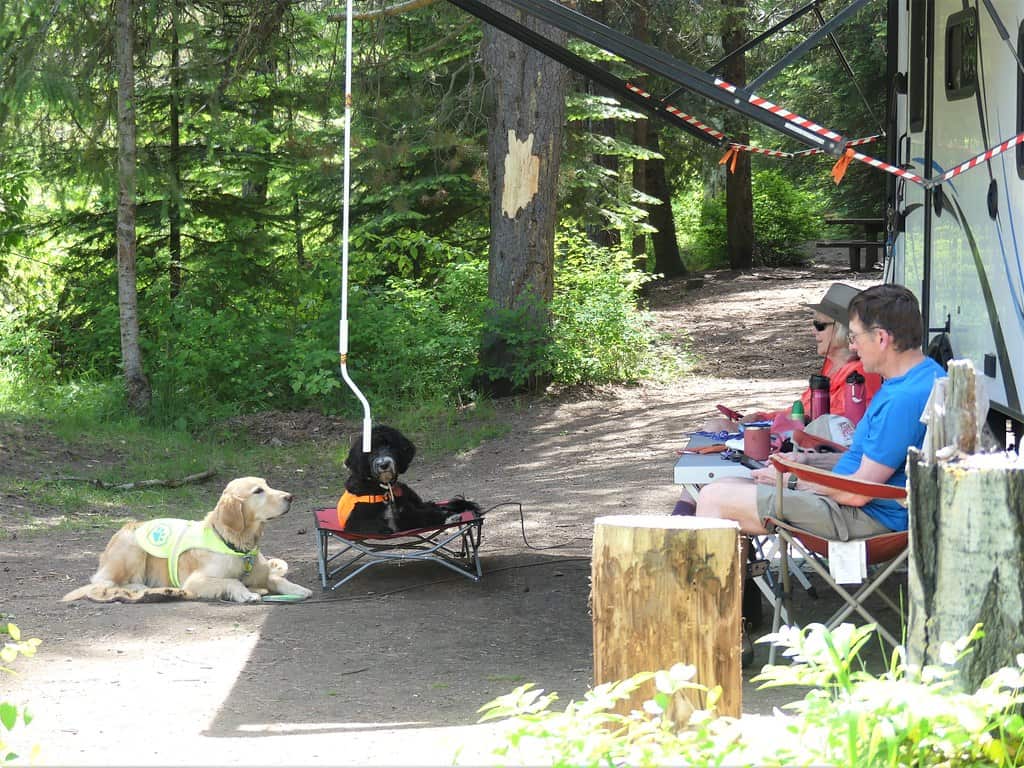
  • A tie-out that actually holds -- a line between two trees beats a stake in soft ground
  • A backup containment plan for open sites with no trees
  • A crash-tested car restraint for the drive, never a collar

Safety and visibility

  • A clip-on collar light, because a dark dog at a campsite after dark is invisible
  • Reflective or high-visibility guylines, so the dog does not run through them
  • A first aid kit covering the dog, including a tick remover
  • Something to cover a damaged paw pad -- a bootie or self-adhesive bandage
  • Boots, if the terrain is hot rock, sharp scree or icy salted ground

Cleanliness

  • Waste bags, more than you think, plus a sealed bag to carry used ones out
  • A towel for paws, which is what keeps the tent habitable
  • A brush, for burrs and seeds -- grass awns in particular are a genuine veterinary problem
  • A tick remover and the knowledge of how to use it

Paperwork

  • Vaccination records, especially crossing state lines or if you might need a vet or a kennel
  • Your vet's number, and the number of an emergency vet near your destination
  • A current photo of the dog on your phone, in case it gets lost
  • Confirmation that the campground actually allows dogs, and on what terms

02 — Before you go

Check the rules before you book

Dog rules at campgrounds and on the trails around them vary considerably, and this is where dog owners get caught out most often.

  1. 01Are dogs allowed at the campground at all? Most are, and some are not, and some limit the number per site.
  2. 02Are dogs allowed on the trails nearby? This is the one that surprises people -- many national parks allow dogs in campgrounds while prohibiting them on almost all trails.
  3. 03What is the leash rule? Usually absolute, often with a maximum length specified. A long retractable lead may not comply.
  4. 04Can the dog be left unattended? Almost always no, and it is unsafe regardless.
  5. 05Are there seasonal restrictions? Some areas close to dogs during wildlife breeding seasons.
  6. 06Is there water at the site? Many campgrounds shut water off outside the peak season, which affects how much you carry.

03 — Failure modes

What actually goes wrong

The problems are specific and predictable, which makes them preventable.

  • The dog punctures your sleeping pad. The most commonly reported pad failure. Give the dog its own foam mat. See sleeping pads.
  • Claws go through a thin tent floor. Buy a car-camping tent with a thick floor and use a footprint. See tents for camping with dogs.
  • The dog pushes through a mesh door. Practice the dog waiting at the door before the trip, with the tent pitched at home.
  • The tie-out stake pulls out. Stakes come out of soft ground very easily. A line between two trees does not.
  • The dog runs through a guyline and collapses the tent, or hurts itself. Use high-visibility lines.
  • Barking all night. The thing that gets dogs banned from campgrounds. If your dog has never slept in a tent, try it in a yard first.
  • Grass awns and burrs. Seeds that work into ears, paws and skin and need veterinary removal. Brush the dog down after every walk.

04 — Preparation

Practice before the trip

The cheapest and most effective preparation costs nothing and happens at home.

  • Pitch the tent in a yard and let the dog explore it. A flapping fabric box is strange, and a calm afternoon is a better introduction than a campsite at dusk.
  • Let the dog sleep in it once at home if it never has. Discovering that your dog barks all night in a tent is better learned in a yard.
  • Introduce the mat inside the tent, so the dog knows where its spot is.
  • Practice waiting at the door rather than pushing at it. This is what saves the mesh.
  • Clip nails before you go. Obvious, effective, routinely forgotten.
  • Do a short trip first. One night close to home tells you what a week away would have taught you expensively.

What to buy

The gear we would buy for this

Trail & Terminal earns a commission when you buy through our Amazon links, at no extra cost to you. It does not change which products we pick -- see our affiliate disclosure and selection method.

1

Best for the one item not to skip

Therm-a-Rest Z Lite Sol

Closed-cell foam the dog cannot puncture. Saves your pad, insulates the dog, and can be cut to size.

The cheapest item on the list and the one that prevents the most expensive problem. Cut it down to the dog's size to save bulk. See <a href="/trail-dog/best-dog-camping-gear">dog camping gear</a>.

Specs

  • Accordion-folding closed-cell foam
  • Moderate manufacturer-stated R-value
  • Nothing to inflate or puncture
  • Can be cut to size

Good for

  • Gives the dog a designated spot, which prevents most pad and floor damage
  • Insulates the dog from cold ground
  • Cannot be punctured

Bad at

  • No washable cover
  • Bulky folded and does not compress
  • Some dogs will still prefer your pad
2

Best for containment that actually works

Ruffwear Knot-a-Hitch Dog Hitching System

A line between two trees with a sliding attachment. Holds where a stake will not.

Stakes pulling out of soft ground is the most common dog containment failure at a campsite. Bring a backup plan for sites with no trees, and check the campground's leash rules -- a tie-out at your own site is normally the accepted arrangement.

Specs

  • Static rope line with a locking carabiner and sliding attachment
  • Rigs between two trees or anchor points
  • Rated for canine use per Ruffwear
  • Packs into an included bag

Good for

  • Cannot be pulled out, unlike a stake in soft ground
  • The sliding attachment stops the dog winding itself up
  • Properly rated rope and hardware

Bad at

  • Needs two anchor points
  • Takes a few minutes to rig
  • More expensive than a stake and a cable
3

Best for seeing the dog after dark

Ruffwear The Beacon Safety Light

A dark-coated dog at a campsite at night is invisible. This is a safety item.

Genuinely a safety item rather than an accessory, especially at a campsite with vehicles moving and guylines strung at ankle height. Check the clip is closed each time.

Specs

  • Rechargeable LED with USB charging
  • Multiple modes including strobe
  • Manufacturer-stated waterproof rating
  • Clips to a collar or harness

Good for

  • Makes a dark dog visible around fire rings, guylines and vehicles
  • Rechargeable, so no coin cell to lose
  • Waterproof, which dogs require

Bad at

  • Easy to lose if the clip is not properly closed
  • Needs charging before the trip
  • Strobe modes annoy other campers

Questions

Frequently asked

What do I need to pack for a dog when camping?
The dog's own foam mat, water and a bowl, a tie-out that holds, a harness and a collar with ID, a collar light, waste bags, their food in a sealed container, a towel for paws, a first aid kit with a tick remover, and vaccination records.
Are dogs allowed at campgrounds?
Usually at the campground and often not on the trails nearby, which is the surprise that catches people out -- national parks in particular frequently prohibit dogs on almost all trails. Check the managing agency's page before booking, including seasonal restrictions.
Where should my dog sleep when camping?
In the tent, on its own closed-cell foam mat. Leaving a dog outside unattended is usually prohibited and unsafe anyway, and a foam mat keeps the dog off your inflatable pad -- which is the most commonly reported cause of pad punctures.
How do I keep my dog from running off at a campsite?
A line rigged between two trees with a sliding attachment, rather than a stake -- stakes pull out of soft ground very easily. Bring a backup for sites with no trees, and never leave the dog unattended, which most campgrounds prohibit.
What should I do before taking my dog camping for the first time?
Pitch the tent at home and let the dog explore it, let it sleep in there once, introduce its mat inside, practice it waiting at the door rather than pushing, and clip its nails. Then do one night close to home before a longer trip.

Back up a level

This page sits in Trail Dog -- kit for the dog that comes along.

Read next