Skip to content
Trail & Terminal

06 — Trail Dog / Roundup

Best dog travel accessories

Most dog travel accessories are about comfort. The one that matters is restraint, because an unrestrained dog in a crash is a projectile.

By Brijon M.Last updated How we pick
A dog secured in the back of a car with a travel harness

The short answer

Buy a crash-tested restraint first -- a harness with a seatbelt tether or a secured crate. Everything else is comfort: a seat cover, a collapsible bowl, bedding and a window shade. Never let a dog travel loose or with its head out of a window.

Trail & Terminal earns a commission when you buy through our Amazon links, at no extra cost to you. It does not change which products we pick -- see our affiliate disclosure and selection method.

Our picks at a glance

Best dog travel accessories -- ranked picks
#ProductBest forKey specPrice
1Sleepypod Clickit Sport Crash-Tested HarnessAn actually crash-tested harness. Most dog car harnesses have never been tested at all.the only thing that genuinely mattersCrash-tested restraint
2Gunner Kennels G1 Dog CrateA rigid crash-tested crate. Heavy, expensive, and the most protective option there is.the strongest protectionCrash-tested rigid crate
3Kurgo Wander Hammock Seat CoverA hammock-style cover that stops a dog slipping into the footwell. Not a restraint.keeping the car habitableHammock seat cover
4Ruffwear Quencher Collapsible BowlPacks flat, holds its shape when full, and lives in a door pocket permanently.water at every stopCollapsible, stiffened rim
5Ruffwear Highlands Dog BedA packable insulated dog bed that rolls into a stuff sack. Works in a car and at a campsite.a bed that travelsPackable insulated bed
6EzyDog Vent Window Sun ShadeA mesh shade for a cracked window. Helps with airflow, and is not a substitute for not leaving the dog.a parked car in the shadeWindow mesh shade

Ranked by the criteria in how we pick. We hold no live prices, so every button goes straight to the current Amazon listing.

Every pick, in full

The picks

1

Best for the only thing that genuinely matters

Sleepypod Clickit Sport Crash-Tested Harness

An actually crash-tested harness. Most dog car harnesses have never been tested at all.

The distinction that matters: most dog car harnesses have never been crash tested, and a tether clipped to a walking harness provides very little protection in a collision. Independently tested restraints are a small subset of the market and this is one of them. The Center for Pet Safety publishes testing results, which is the right place to check any product making a safety claim. Bulky and expensive, and it is the one item here worth paying for.

Specs

  • Harness designed to route the vehicle seatbelt through it
  • Independently crash-tested per Sleepypod's published results
  • Padded vest construction spreading load across the chest
  • Sized by girth

Good for

  • Independently tested, which the overwhelming majority of dog car harnesses are not
  • Spreads crash force across the chest rather than the neck
  • Uses the car's own seatbelt, which is the strongest anchor available

Bad at

  • Expensive compared with untested harnesses
  • Bulky to wear, so it is a car harness rather than a walking one
  • Restricts movement, which some dogs resist initially
2

Best for the strongest protection

Gunner Kennels G1 Dog Crate

A rigid crash-tested crate. Heavy, expensive, and the most protective option there is.

A rigid crate properly anchored is the most protective arrangement for a dog in a vehicle, and the tested ones are a small subset of the market. It doubles as secure containment at a campsite, which is genuinely useful. Two honest points: it is large enough to dominate a cargo area, and <strong>an unanchored crate is dangerous</strong> -- the strap-down points are not optional. Check the Center for Pet Safety for current testing results.

Specs

  • Double-wall rotomolded construction
  • Independently crash-tested per Gunner's published results
  • Strap-down anchor points
  • Multiple sizes

Good for

  • A rigid tested crate is the most protective option available for a dog in a vehicle
  • Also serves as secure containment at a campsite
  • Rotomolded construction survives genuine abuse

Bad at

  • Very heavy and bulky -- it claims a large fixed share of the cargo area
  • The most expensive option here by a wide margin
  • Must be properly strapped down, or it becomes a projectile itself
3

Best for keeping the car habitable

Kurgo Wander Hammock Seat Cover

A hammock-style cover that stops a dog slipping into the footwell. Not a restraint.

Useful and frequently mistaken for a safety product. The hammock configuration genuinely stops a dog sliding into the footwell under hard braking, which is a comfort and minor safety benefit, and it keeps a car liveable. But it does nothing in a collision, and it should be used with a tested restraint rather than instead of one. Note the slippery fabric can be hard for an older dog to grip.

Specs

  • Water-resistant fabric covering the rear bench
  • Hammock configuration raising the footwell
  • Openings for seatbelt tethers
  • Machine washable

Good for

  • The hammock configuration stops a dog sliding into the footwell under braking
  • Protects upholstery from hair, mud and claws
  • Washable, which is the whole point for a dog product

Bad at

  • <strong>Not a restraint</strong> -- it contains mess, not a dog in a crash
  • Reduces rear passenger space when configured as a hammock
  • Fabric can be slippery for an older dog to grip
4

Best for water at every stop

Ruffwear Quencher Collapsible Bowl

Packs flat, holds its shape when full, and lives in a door pocket permanently.

Dogs get dehydrated on long drives, particularly in a warm car, and the practical barrier is not carrying water but having a bowl to hand at a stop. One that packs flat and lives in a door pocket removes that barrier. <strong>Never leave a dog in a parked car in warm weather</strong> -- a vehicle interior heats dangerously fast even with windows cracked. See <a href="/trail-dog/best-dog-camping-gear">dog camping gear</a>.

Specs

  • Coated polyester with a stiffened rim
  • Collapses flat
  • Water-resistant lining
  • Machine washable

Good for

  • Lives in a door pocket, so water is always available at a stop
  • The stiffened rim keeps it usable when full
  • Machine washable

Bad at

  • Seams seep eventually
  • Light enough to move if the dog pushes it
  • Not insulated, so water in a hot car warms fast
5

Best for a bed that travels

Ruffwear Highlands Dog Bed

A packable insulated dog bed that rolls into a stuff sack. Works in a car and at a campsite.

A dog that has its own familiar bed settles faster in a car, a hotel and a tent, which is worth more than it sounds on a trip with several stops. Insulation matters because a cargo floor and cold ground both pull heat out of a dog. A folded blanket does much of the job for free; this packs smaller and insulates better, which is the argument for it.

Specs

  • Synthetic insulated pad with a durable shell
  • Rolls into an integrated stuff sack
  • Water-resistant base
  • Machine washable cover on some versions

Good for

  • A familiar bed helps a dog settle in an unfamiliar place, which is a real behavioral benefit
  • Insulated, so it works on a cold vehicle floor or cold ground
  • Packs down, unlike a household dog bed

Bad at

  • Expensive compared with a folded blanket
  • Synthetic insulation flattens over time
  • Bulky packed compared with a foam mat
6

Best for a parked car in the shade

EzyDog Vent Window Sun Shade

A mesh shade for a cracked window. Helps with airflow, and is not a substitute for not leaving the dog.

Useful for a dog traveling in a sunny back seat, and genuinely useful for preventing a dog putting its head out of a cracked window -- which risks eye and ear injuries from debris. The important caveat, stated plainly: <strong>no shade or cracked window makes it safe to leave a dog in a parked car in warm weather.</strong> Vehicle interiors heat dangerously fast, and that is the single most important fact in this entire category.

Specs

  • Mesh panel fitting over a partly open window
  • Blocks direct sun while allowing airflow
  • Universal fit for most car windows
  • Prevents a dog putting its head out

Good for

  • Blocks direct sun on a dog in a back seat while allowing airflow
  • Stops a dog putting its head out of a cracked window, which is a genuine injury risk
  • Cheap and takes no space

Bad at

  • <strong>Does not make it safe to leave a dog in a parked car.</strong> Nothing does, in warm weather
  • Universal fit means an imperfect fit on many windows
  • Mesh reduces visibility for passengers

01 — The priority

Restraint is the only safety item here

Most dog travel accessories are comfort products, and there is nothing wrong with that -- but one category is a safety item and it is worth separating from the rest.

An unrestrained dog in a collision is a projectile, dangerous to itself and to everyone in the vehicle. It can also prevent emergency responders from reaching occupants, or escape into traffic after a crash. That is the case for restraint, and it does not depend on how well behaved the dog is.

Most dog car harnesses have never been crash tested. This is the crucial thing to understand before buying: a tether clipped to an ordinary walking harness is not a restraint system, and the market is full of products whose safety claims rest on nothing. The Center for Pet Safety publishes independent crash testing results, and checking there is the right way to evaluate any product making a safety claim.

The two arrangements with genuine testing behind them are a tested harness routing the vehicle's own seatbelt, and a rigid tested crate properly strapped down. An unanchored crate is itself a hazard, so the strap-down is not optional.

02 — Safety

The two rules that matter most

Never leave a dog in a parked car in warm weather

A vehicle interior heats far faster and far higher than people expect, and cracking a window makes very little difference. Dogs cool by panting, which works poorly in hot still air, and heatstroke develops quickly and can be fatal.

There is no version of this that is safe on a warm day -- not for a few minutes, not in shade, not with the windows down. The practical answer on a road trip is that one person stays with the dog, or you take the dog with you, or you do not stop there. Veterinary bodies including the AVMA publish guidance on this.

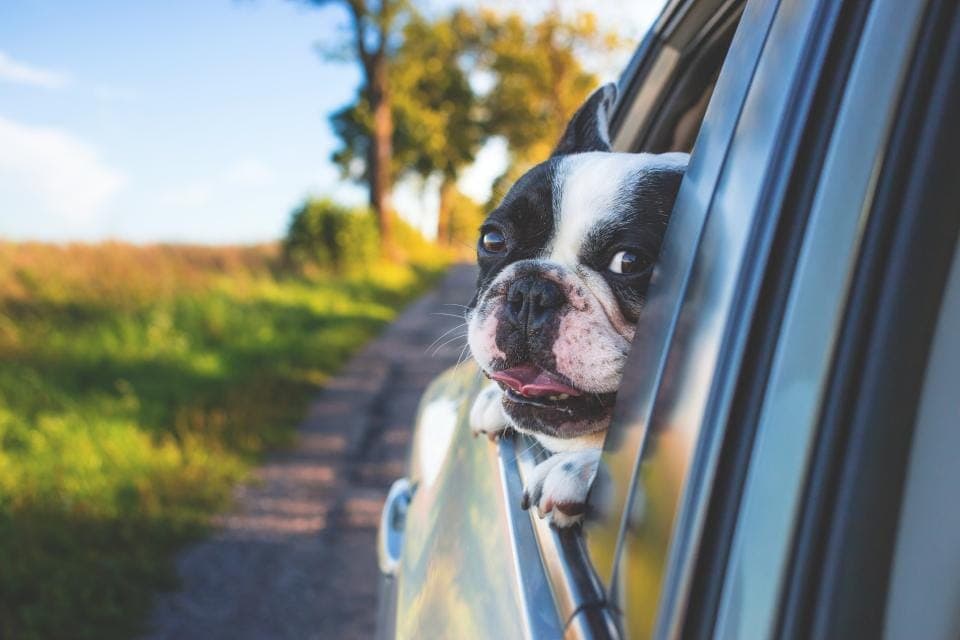
Do not let a dog travel with its head out of a window

It looks like the dog enjoying itself and it carries real risks: debris and insects at speed cause eye and ear injuries, and a dog leaning out can fall or jump. Sudden braking with a dog partly out of a window is also a serious hazard.

A mesh window shade or a window set only slightly open solves it while keeping airflow. This is a small change that prevents a specific and reasonably common injury.

03 — Practicalities

Long drives with a dog

  • Stop every two to three hours for water, a toilet break and a short walk. Dogs need it more often than people on the same drive.
  • Feed lightly before traveling. A full stomach plus motion is how carsickness happens. Water is fine; a large meal is not.
  • Bring more water than you think, in the cabin rather than only in a cooler, and offer it at every stop.
  • Bring their own bedding. A familiar bed helps a dog settle in unfamiliar places, which matters on a multi-stop trip.
  • Keep a copy of vaccination records, especially crossing state lines or if you might need a vet or a kennel.
  • Know where emergency vets are on your route. Five minutes of planning, and the thing you want to have done.
  • A dog that has never done a long drive should do a short one first. Finding out about carsickness two hours from home is better than six.

04 — Criteria

How we ranked these accessories

Whether the item is a genuine safety product with testing behind it first, then whether it solves a real problem on a long drive, then durability and whether it can be cleaned. Full method on how we pick.

We have not crash tested anything and we are not in a position to. Crash-test claims are each manufacturer's published results, and the Center for Pet Safety publishes independent testing which is the right source to check. Nothing here is veterinary advice -- for heat, travel sickness or your dog's fitness to travel, ask your vet.

Questions

Frequently asked

Do dogs need to be restrained in a car?
For safety, yes -- an unrestrained dog in a collision is a projectile, dangerous to itself and everyone else, and can escape into traffic afterwards. Use a crash-tested harness routing the vehicle's seatbelt, or a rigid tested crate that is properly strapped down.
Are dog car harnesses actually crash tested?
Most are not, which is the crucial thing to know. A tether clipped to an ordinary walking harness is not a restraint system. The Center for Pet Safety publishes independent crash testing results, and that is the right place to check any product making a safety claim.
Is it safe to leave a dog in a car with the windows cracked?
No. A vehicle interior heats far faster and higher than people expect, and cracking a window makes very little difference. Dogs cool by panting, which works poorly in hot still air. There is no safe version of this on a warm day -- not even for a few minutes.
Can my dog put its head out of the car window?
Better not. Debris and insects at speed cause eye and ear injuries, and a dog leaning out can fall or jump. A mesh window shade, or opening the window only slightly, keeps the airflow while removing the risk.
How often should I stop on a road trip with a dog?
Every two to three hours for water, a toilet break and a short walk -- more often than people on the same drive. Feed lightly before traveling, since a full stomach plus motion is how carsickness happens, and offer water at every stop.

Back up a level

This page sits in Trail Dog -- kit for the dog that comes along.

Read next