Skip to content
Trail & Terminal

01 — Camp / Guide

What size tent do I need?

A four-person tent sleeps four people with no gear, no pets and no room to sit up. The rating is a floor measurement, not a recommendation.

By Brijon M.Last updated How we pick
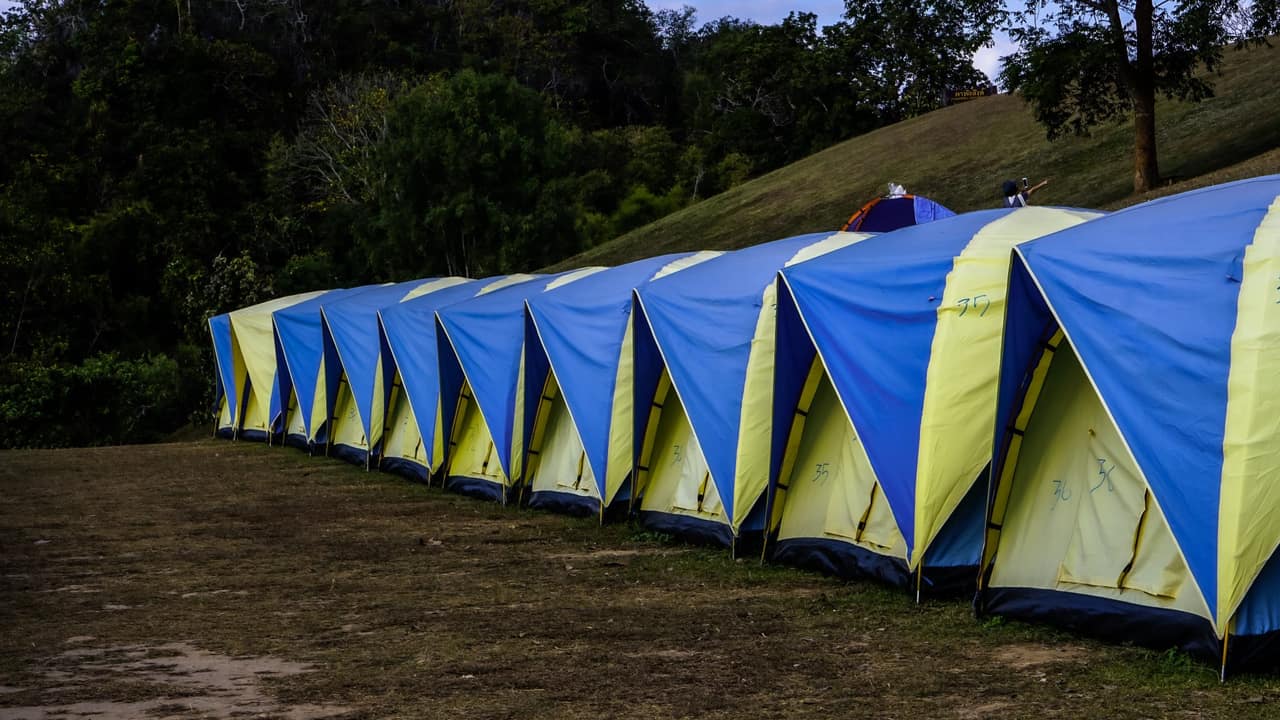
A dome tent pitched on flat ground at a wooded campsite

The short answer

Add one to your head count for car camping, two if you have a dog or small children. A tent's person rating assumes sleeping pads touching edge to edge with no gear inside, which nobody actually does.

01 — The number

What a person rating actually means

Tent capacity is not regulated and not standardized. In practice, manufacturers arrive at the figure by laying out the maximum number of standard 20-inch-wide sleeping pads that fit side by side on the floor with no gaps. That is the whole calculation.

It assumes no gear in the tent, nobody rolling over, no pet, and no space to put a bag down. It also assumes everyone is roughly standard height and sleeping in the same orientation. For a backpacking tent, where the goal is minimum weight and everyone accepts the squeeze, this is a reasonable way to express the floor size. For car camping it is misleading.

The useful way to read the box is as a floor measurement. A 4-person tent is a tent with roughly 55 to 65 square feet of floor, which is a different and much more actionable statement.

02 — The math

Floor area you actually want

Here is how the rated capacity maps to real comfort. The middle column is the number of people the tent is genuinely pleasant for when it is also holding their gear.

Rated sizeTypical floorComfortable forGood for
2-person28 - 35 sq ft1 adult plus gearSolo backpacking, two people packing light
3-person40 - 45 sq ft2 adults plus gearCouples car camping
4-person55 - 65 sq ft2 adults and a child, or 3 adultsSmall families
6-person85 - 100 sq ft4 people plus gearFamilies, dog owners
8-person110 - 130 sq ft5 to 6 people plus gearLarge groups, long stays

03 — Sizing

The plus-one rule, and when to make it plus-two

For car camping, buy one size above your head count. The extra floor costs very little money and no carrying effort, and it is the difference between a tent you dress in and a tent you crawl into.

Make it plus-two if any of the following apply: a dog comes along, you have children young enough to need a parent within arm's reach, you camp in places where rain will keep you inside for a day, or anyone in the group is over about six feet tall. Each of those eats floor area in a way the rating does not account for.

For backpacking the calculation inverts, because every square foot is weight you carry. There, the rating is close to honest and most people accept the squeeze. A two-person backpacking tent for two people is normal; a two-person car camping tent for two people is a mistake.

What size tent for a family of four?

A 6-person tent. Four people in a 4-person tent means pads edge to edge, gear outside in the vestibule or in the car, and nowhere to put a child who wakes up. The step from 4 to 6 typically adds 30 square feet for a modest price increase. See best camping tents.

What size tent for two people car camping?

A 3-person or 4-person tent. Two people in a 3-person have room for bags inside and can both sit up; in a 2-person they have exactly enough floor for two pads. If you ever camp in weather, take the 4.

What size tent if a dog is coming?

Add a full person for a medium or large dog, who will take a sleeping-pad-sized footprint and will move around in the night. Add one anyway for a small one. Dog-specific tent considerations -- floor durability and vestibule space -- are in best tents for camping with dogs.

04 — Specs

The measurements that matter more than capacity

Once you have a floor area in mind, three other numbers decide whether the tent is pleasant.

  • Peak height. Under about 45 inches you crawl; around 60 inches you sit up comfortably; above 72 inches most adults can stand. Cabin-style tents trade pack size and wind stability for this.
  • Floor length. Many tents are 84 to 90 inches long, which is tight for anyone over 6 feet once a pillow is involved. Check the number rather than the rating.
  • Vestibule area. A vestibule is covered floor outside the mesh for boots and packs. A tent with two 10-square-foot vestibules effectively has 20 more square feet of usable space.
  • Door count. Two doors on a tent for two or more people means nobody climbs over anybody at 3am. It is one of the highest-value features per dollar.
  • Wall shape. Near-vertical walls make the rated floor area usable; steeply sloping dome walls mean the outer foot of floor on each side is only good for gear.
  • Packed size and weight, if it ever goes on your back. A 6-person tent is a car-camping object and nothing else.

05 — Tradeoffs

Where bigger stops being better

Buying up has real costs beyond the price. A larger tent is harder to pitch alone, takes a bigger flat pad of ground than many sites provide, and catches far more wind -- a tall cabin tent in an exposed site is a genuinely different proposition from a low dome.

Large tents are also colder, because the same amount of body heat is warming more air. In shoulder-season camping a right-sized tent is noticeably warmer than an oversized one, which is the only argument in this entire guide for buying smaller.

Check the site before you buy for a specific trip. Many established campgrounds have tent pads of a fixed size, often around 12 by 12 feet, and an 8-person cabin tent does not fit on one. Related reading: camping vs backpacking tent and tent vs hammock camping.

What to buy

The gear we would buy for this

Trail & Terminal earns a commission when you buy through our Amazon links, at no extra cost to you. It does not change which products we pick -- see our affiliate disclosure and selection method.

1

Best for two people who carry their tent

REI Co-op Half Dome SL 2+

The plus in the name is the point -- a 2-person tent with the floor width of something closer to a 3.

This is the tent that makes the plus-one rule unnecessary for couples, because the manufacturer already applied it. Thirty-five square feet for two is the point where a tent stops being a coffin.

If the tent never goes on your back, you can get more floor for less money elsewhere. The argument for this one is that it does both jobs. Full field in <a href="/camp/best-camping-tents">best camping tents</a>.

Specs

  • Roughly 35 sq ft of floor
  • Two doors and two vestibules
  • Near-vertical walls at the shoulder
  • Packs small enough to split between two packs

Good for

  • Two doors means no climbing over a sleeping partner
  • Wall shape makes the rated floor genuinely usable
  • Light enough to backpack with, roomy enough to car camp in

Bad at

  • Still tight for two adults plus a week of gear
  • Peak height is a sit-up tent, not a stand-up one
  • Costs considerably more than a big-box 4-person tent
2

Best for two adults car camping on a budget

Coleman Sundome 4-Person

Rated for four, genuinely good for two plus gear. A clean demonstration of the plus-one rule in practice.

If the question is what size tent to buy and the answer is constrained by budget, this is the shape of the answer: buy a cheap tent one or two sizes up rather than an expensive tent at your head count.

The compromise is weather. Fiberglass poles and a partial fly are fine in a forecast you have checked and poor in one you have not. Pitch it with the door away from the wind and guy it out properly.

Specs

  • Around 63 sq ft of floor
  • 59 inch peak height
  • Single door, small vestibule
  • Fiberglass poles

Good for

  • Cheap enough that oversizing costs almost nothing
  • Sits-up height for most adults
  • Simple two-pole pitch that one person can do

Bad at

  • Fiberglass poles splinter rather than bend, and do not survive real wind
  • One door, so somebody is climbing over somebody
  • Minimal vestibule means wet boots come inside
3

Best for a family of four, correctly sized

Coleman Skydome 6-Person

Around 100 square feet and enough height to stand in the middle. This is what a family of four should actually be buying.

The upgrade from a 4-person to a 6-person for a family of four is the single highest-value sizing decision in camping. It converts the tent from a place you sleep into a place you can wait out weather.

Measure the site if you are going somewhere with marked pads. Height is what you are buying here, and height is also what makes it a sail -- see the wind notes in <a href="/camp/best-camping-tents">best camping tents</a>.

Specs

  • Roughly 100 sq ft of floor
  • 72 inch peak height
  • Pre-attached poles, fast pitch
  • Full-coverage rainfly

Good for

  • Four people plus gear with room to move, which a 4-person tent does not give
  • Stand-up height changes a rained-out day completely
  • Pitches in a few minutes without reading anything

Bad at

  • Needs a large, genuinely flat pad -- it will not fit some established tent pads
  • Tall walls catch wind, so guying out is not optional
  • Heavy and bulky packed; strictly a car-camping tent
4

Best for near-vertical walls and real usable floor

NEMO Aurora Highrise 4P

A 4-person tent whose walls go almost straight up, so the rated floor area is floor you can use.

Included to make the wall-shape point concrete. Two tents with identical floor areas can feel a size apart because one has near-vertical walls and the other slopes away from head height.

If you are comparing tents on paper, look for peak height alongside floor area, and for a wall profile in the product photos that does not taper immediately. That combination is what you are actually paying for at this tier.

Specs

  • Around 62 sq ft of floor
  • 77 inch peak height
  • Two doors, two vestibules
  • Aluminum poles

Good for

  • Wall angle makes a 4-person footprint feel like a larger tent
  • Aluminum poles flex in wind instead of splintering
  • Two doors and two vestibules for four people

Bad at

  • Expensive compared with big-box tents of the same rating
  • Tall profile still catches wind despite the better poles
  • Heavy packed, like every cabin-style tent

Questions

Frequently asked

What size tent do I need for 2 people?
For car camping, a 3-person or 4-person. For backpacking, a 2-person is normal because weight matters more. A 2-person rating means two sleeping pads edge to edge with nothing else on the floor.
What size tent do I need for a family of 4?
A 6-person tent. Four people in a 4-person tent leaves no floor for gear, no room to sit up together, and no space for a child who wakes in the night. The extra 30 square feet costs little.
Are tent person ratings accurate?
They are accurate as floor measurements and misleading as recommendations. The rating is the number of 20-inch sleeping pads that fit side by side with no gear. Read the square footage instead.
Should I size up my tent if I have a dog?
Yes -- count a medium or large dog as a full person. A dog takes a sleeping-pad-sized footprint, moves around overnight, and brings in dirt that needs somewhere to be that is not your sleeping bag.
Is a bigger tent always better?
No. Larger tents need a bigger flat site, catch more wind, are harder to pitch alone, and are colder because the same body heat warms more air. For shoulder-season camping a right-sized tent is warmer.
What peak height do I need to stand up in a tent?
About 72 inches for most adults, though it only applies at the center of the tent. Around 60 inches lets you sit upright comfortably, and under 45 inches you are crawling.

Back up a level

This page sits in Camp -- campsite kit: shelter, sleep, kitchen, light and power.

Read next