Skip to content
Trail & Terminal

02 — Trail / Roundup

Best camping knives

Camp knife work is food prep, cord, packaging and the occasional bit of kindling. Almost every knife marketed for survival is the wrong tool for that list.

By Brijon M.Last updated How we pick
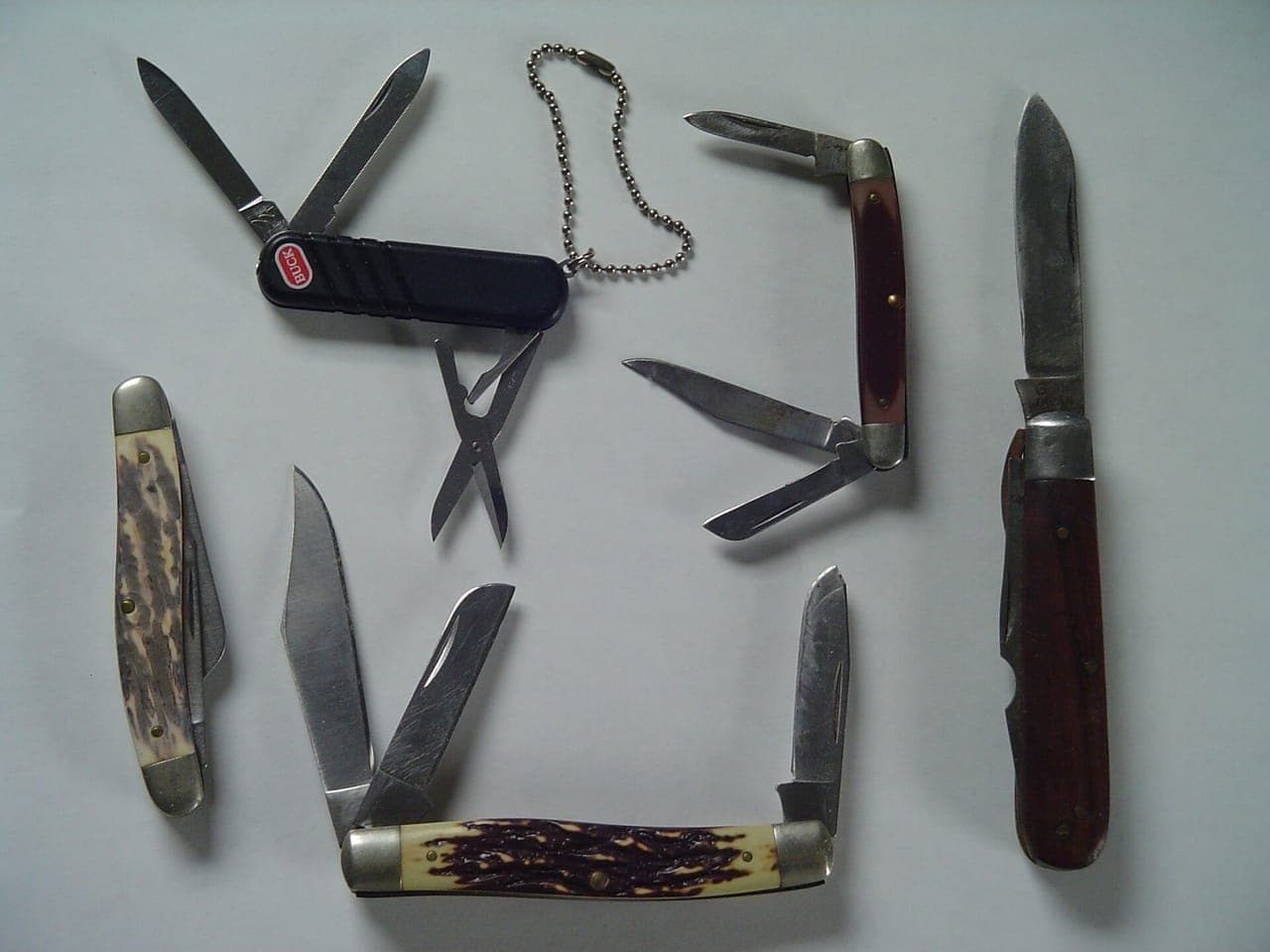
A folding pocket knife and a fixed-blade knife on a wooden surface

The short answer

The Morakniv Companion is the best camping knife for most people: a cheap, sharp fixed blade that handles food prep and kindling without pretending to be a survival tool. If you want one knife in a pocket instead, the Opinel No. 8 does nearly as much.

Trail & Terminal earns a commission when you buy through our Amazon links, at no extra cost to you. It does not change which products we pick -- see our affiliate disclosure and selection method.

Our picks at a glance

Best camping knives -- ranked picks
#ProductBest forKey specPrice
1Morakniv CompanionThe best value in camp cutlery. Sharp out of the box, easy to resharpen, and cheap enough to keep one in every bag.most campers4in fixed blade
2Opinel No. 8A wooden-handled folder that has been the same design for over a century. Excellent at food, light on everything else.one knife in a pocket3.3in folding blade
3Victorinox HuntsmanThe multi-tool that earns its place: scissors, a saw, a bottle opener and a screwdriver you will actually use.the tools around the blade15 functions
4Benchmade BugoutVery light for its blade length, locks solidly, and opens one-handed. The pick if the knife lives in your pocket year round.carrying it every day3.24in, ~1.9oz
5Gear Aid Tenacious Tape Repair PatchesHalf the time you reach for a knife at camp, the actual job is a repair. Tape solves what cutting cannot.what the knife is usually forAdhesive fabric patches

Ranked by the criteria in how we pick. We hold no live prices, so every button goes straight to the current Amazon listing.

Every pick, in full

The picks

1

Best for most campers

Morakniv Companion

The best value in camp cutlery. Sharp out of the box, easy to resharpen, and cheap enough to keep one in every bag.

This is the knife to buy if you have not thought about it much, and the one plenty of people who have thought about it a great deal still carry. The Scandi grind is the reason: a single bevel that you can sharpen flat on a stone without any skill, which matters because a sharp cheap knife is safer and more useful than a blunt expensive one.

It does all four real camp jobs -- food prep, cutting cord, opening packaging, and splitting small kindling with a baton -- and it refuses to pretend to be a survival knife. The tang is partial, so it is not the tool for prying or heavy chopping. For the money there is nothing close, and the carbon steel version takes a keener edge if you accept wiping it dry.

Specs

  • Roughly 4in Sandvik stainless or carbon steel blade
  • Scandi grind -- simple to resharpen by hand
  • Rubberized handle with a positive grip wet
  • Plastic sheath with a drain hole

Good for

  • Cuts well straight from the box and takes an edge back easily with a basic stone
  • Fixed blade with no pivot, so there is nothing to loosen or clog
  • Cheap enough that losing one is annoying rather than expensive

Bad at

  • No full tang -- not a knife for prying or hard chopping
  • The plastic sheath retains the knife by friction and can loosen over years
  • Carbon steel versions rust if you put them away damp
2

Best for one knife in a pocket

Opinel No. 8

A wooden-handled folder that has been the same design for over a century. Excellent at food, light on everything else.

If your camping is drive-in sites and the knife's job is cheese, bread, vegetables and string, this is arguably the better buy. The blade is thin, which is why it cuts food so well -- thick "survival" blades wedge in a tomato. It is also the knife you will actually have on you, because it disappears in a pocket.

The limits are honest and well known. The beechwood handle swells with water and the pivot can get stiff; a drop of oil and keeping it out of the washing-up bowl solves most of it. And it is a folder, so there is a pivot between you and the blade -- no prying, no baton work. Pair it with a small saw rather than asking it to process wood.

Specs

  • Roughly 3.3in blade, carbon or stainless
  • Beechwood handle with a Virobloc locking collar
  • No pocket clip -- it is a pocket knife, not a tactical folder
  • Very light for the blade length

Good for

  • Slices food better than almost any thicker knife, which is the main camp job
  • Folds to nothing and weighs very little
  • The locking collar can be turned to lock the blade closed as well as open

Bad at

  • Wooden handle swells when wet, which can stiffen the pivot
  • Not a knife for any prying or baton work -- the pivot is the weak point
  • Carbon version discolors and rusts without care
3

Best for the tools around the blade

Victorinox Huntsman

The multi-tool that earns its place: scissors, a saw, a bottle opener and a screwdriver you will actually use.

Buy this for the things that are not the knife. At a campsite the scissors cut packaging, tape, bandages and fishing line; the little saw processes a surprising amount of thumb-thick wood; the bottle opener and screwdriver get used at every trailhead. That cluster is why a Swiss Army knife is still the right second blade.

What it is not is a good primary knife. The main blade is short, it does not lock on most models, and the smooth handle gets slippery with wet hands or fat from cooking. The sensible setup for most people is this plus one of the two picks above -- and it is worth noting the 30-function versions add almost nothing but bulk. Our <a href="/camp/best-camping-gear-for-beginners">beginner camping gear</a> guide makes the same point.

Specs

  • Two blades plus a wood saw and scissors
  • Can opener, bottle opener and screwdriver tips
  • Corkscrew and awl
  • Swiss-made with a lifetime guarantee against defects

Good for

  • The scissors and the small saw are genuinely the most-used tools at a campsite after the blade
  • Light and compact for how many functions it carries
  • Covered by a real guarantee against material and manufacturing defects

Bad at

  • Main blade is short and the handle is slippery wet -- a poor dedicated cutter
  • No locking blade on most models, which limits what you should push it through
  • The corkscrew and awl are dead weight for most campers
4

Best for carrying it every day

Benchmade Bugout

Very light for its blade length, locks solidly, and opens one-handed. The pick if the knife lives in your pocket year round.

This is the pick for the person whose camping knife is also their everyday knife. The weight is the headline: under two ounces for a blade long enough to be useful means there is no reason to leave it behind, and a knife you have on you beats a better knife in a drawer.

Be clear about the tradeoffs. You are paying a lot, the handle is deliberately light rather than rigid, and the premium steel that holds an edge for months is the same steel that resists your pocket stone when it finally goes dull. If a knife spends eleven months a year in a gear bin, buy the Morakniv instead and spend the difference on a saw.

Specs

  • Roughly 3.24in CPM-S30V or S45VN blade
  • AXIS lock, ambidextrous and one-handed
  • Grivory handle scales, manufacturer-stated weight under 2oz
  • Reversible deep-carry pocket clip

Good for

  • Almost unnoticeable in a pocket for the cutting capability it provides
  • One-handed opening and a strong lock, which matters when your other hand is holding something
  • Premium steel holds an edge far longer between sharpenings

Bad at

  • Several times the price of the Morakniv and the Opinel combined
  • Thin handle scales flex under hard use -- it is a light-duty design
  • Premium steel is harder to resharpen in the field without the right stone
5

Best for what the knife is usually for

Gear Aid Tenacious Tape Repair Patches

Half the time you reach for a knife at camp, the actual job is a repair. Tape solves what cutting cannot.

Included for the same reason the last pick in our other roundups often is not the headline product: because the honest list of camp emergencies is dominated by things tearing, not by things needing cutting. A knife plus a few patches covers far more real failures than a bigger knife does.

Keep the patches with the knife so they are in the same pocket of the same bag. Our <a href="/camp/camping-checklist">camping checklist</a> puts the pair together in the repair line, and the <a href="/trail/best-first-aid-kits">first aid kits</a> roundup covers the human equivalent.

Specs

  • Pre-cut adhesive fabric patches
  • Bonds to tent fabric, sleeping pads and rain shells
  • Flexible and machine washable once applied
  • Packs flat in a wallet or first aid kit

Good for

  • Fixes the failures a knife cannot help with -- a torn fly, a punctured pad, a split jacket
  • Weighs and costs almost nothing, and packs completely flat
  • No cure time; the repair holds immediately

Bad at

  • Not a knife, and will not pretend to be one
  • Needs a clean dry surface, which is awkward in the rain
  • Permanent patches are visible -- a field fix, not a restoration

01 — The real job list

What a camping knife is actually for

Write down what you cut on a camping trip and the list is short: food, cord and webbing, packaging and tape, and sometimes small kindling. That is the entire brief. Almost nothing marketed as a survival or bushcraft knife is optimized for it.

The mismatch shows up in blade thickness. A thick, heavily ground blade is good at prying, chopping and surviving abuse, and it is bad at slicing, because a thick spine wedges in whatever you are cutting. Since most camp cutting is food, a thinner blade is the better tool for almost everyone -- which is why a $15 Mora and a $20 Opinel outperform far more expensive knives on the actual work.

The one job that argues for a stouter fixed blade is splitting kindling by tapping the spine with a piece of wood. If you do that regularly, a fixed blade is required and a folder is not safe for it. If you buy firewood at the camp store, you do not need it.

02 — Comparison

At a glance: five knives compared

Blade lengths and weights below are manufacturer-stated. Check the figure on the exact model you buy -- these families all have several variants.

PickTypeBladeBest atWeak at
Morakniv CompanionFixed blade~4inEverything camp, cheaplyPrying, hard chopping
Opinel No. 8Folder, collar lock~3.3inFood prepWet handling, baton work
Victorinox HuntsmanMulti-toolShortScissors, saw, openersBeing the main knife
Benchmade BugoutFolder, AXIS lock~3.24inEveryday carryPrice, field resharpening
Gear Aid repair patchesn/a -- repairn/aTears and puncturesCutting anything

03 — The decision

Fixed blade or folder

This is the only structural choice in the category, and it comes down to one question: will you ever strike the back of the blade with a piece of wood?

Buy a fixed blade if

You split kindling, process wood, or want the strongest possible blade with no moving parts. A fixed blade has no pivot to loosen, nothing to clog with food or grit, and nothing between your hand and the steel. It is also easier to clean properly, which matters if the same knife does food.

The cost is that it needs a sheath, it rides on a belt or in a pack rather than a pocket, and in some places carrying it in public is treated differently from carrying a folder.

Buy a folder if

The knife's job is food, cord and packaging, and you want it on you without thinking about it. A folder in a pocket gets used constantly; a sheath knife in a bin at the back of the car gets used when you remember it exists.

The limit is the pivot. Do not pry with a folder, do not baton it, and check the lock occasionally. A folder with a loose lock should be retired rather than tolerated.

The honest answer for most people: both

A cheap fixed blade in the camp kitchen box and a small folder or Swiss Army knife in a pocket covers every case for less than the cost of one premium knife. That is the setup most experienced campers converge on, and it is why the first three picks on this page are inexpensive.

04 — Maintenance

Steel, sharpening and the thing that matters most

A sharp cheap knife beats a dull expensive one at everything, including safety -- most knife injuries at a campsite come from forcing a blunt blade. So the practical question is not which steel holds an edge longest but which edge you will actually maintain.

Simpler steels (the Sandvik stainless and carbon steels in a Mora, the carbon in an Opinel) dull faster and come back in two minutes on a cheap stone. Premium powder steels hold an edge for a very long time and then require proper equipment and patience to restore. Neither is better; they fail differently.

  • Carbon steel takes a keener edge and rusts. Wipe it dry, oil it occasionally, and never put it away damp. Stainless is the lower-maintenance choice for a knife that lives in a wet bin.
  • A Scandi grind is the easiest to sharpen by hand. Lay the whole bevel flat on the stone and you are at the correct angle automatically. No jig, no guesswork.
  • Carry a small stone or a pocket sharpener, not a big system. Two minutes at camp keeps a knife usable all trip.
  • Wash the food knife by hand. Dishwashers damage wooden handles, dull edges against other items, and rust carbon steel. This applies to the Swiss Army knife as well.

05 — Legal

Check the law before you pack it

Knife law in the United States is set at the state and often the city level, and it varies more than people expect. Blade length limits, restrictions on fixed blades carried in public, rules on locking versus non-locking folders, and automatic or assisted-opening bans all differ by jurisdiction.

Two practical rules cover most of it. First, check the rules for the state you are driving through, not just the one you live in -- a knife that is legal at home can be a problem two states over. Second, never put any knife in a carry-on bag: TSA rules prohibit knives in the cabin almost without exception, and a folder forgotten in a daypack is one of the most common ways people lose one.

  • Flying with a knife? Checked baggage only, sheathed or wrapped. See our what to pack in a carry on guide for the rest of the prohibited list.
  • National and state parks generally permit ordinary camp knives, but they also have their own rules on wood gathering and fires -- check the managing agency's page.
  • When in doubt, carry less knife. A 3in non-locking folder is the least likely thing to cause a problem anywhere.

06 — Skip list

What we would skip

  • Hollow-handle survival knives. The hollow handle is the weakest possible joint, placed exactly where the load goes. The compass and matches inside are not worth it.
  • 30-function multi-tools. You will use the blade, the scissors, the saw, the bottle opener and one screwdriver. The rest is weight.
  • Serrated main edges. Great on bread and rope, bad at everything else, and essentially unsharpenable in the field. A partly serrated blade gives you a shorter plain edge and a serration you cannot maintain.
  • Machetes and hatchets, for most camping. If you buy firewood at the camp store, a folding saw is lighter, safer and better at the one job.
  • Knives sold on the steel name alone. A premium steel in a badly shaped blade is worse than plain stainless in a good one.

07 — Criteria

How we ranked these

Ranked against the real camp job list -- food, cord, packaging, kindling -- rather than against survival scenarios, with value and maintainability weighted heavily because a sharp cheap knife outperforms a dull expensive one. Full method on how we pick.

We have not field-tested these as a set. Picks rest on published steel and construction specifications, blade geometry, long-run owner reports on what loosens or rusts, and the maintenance realities of each grind. Legal guidance here is general: check the rules for your own jurisdiction before carrying.

Questions

Frequently asked

What kind of knife is best for camping?
A thin-bladed knife around 3in to 4in. Most camp cutting is food, cord and packaging, and a thick survival-style blade is worse at all three. A cheap fixed blade like the Morakniv Companion covers everything including splitting small kindling.
Is a fixed blade or folding knife better for camping?
Fixed blade if you ever split kindling by tapping the spine with wood, because a folder's pivot is not built for it. A folder if the job is food and cord and you want the knife on you. Many campers carry a cheap one of each.
What size camping knife do I need?
Three to four inches of blade handles every normal camp task. Longer blades are harder to control for food prep and more likely to run into local length restrictions. Length is not what makes a knife capable; geometry and sharpness are.
Can you bring a camping knife on a plane?
Not in a carry-on. TSA rules prohibit knives in the cabin almost without exception. Pack it in checked baggage, sheathed or wrapped so it cannot injure a handler. A folder forgotten in a daypack is a common way to lose one.
How often should you sharpen a camping knife?
Whenever it stops biting into a tomato skin without pressure. Simple steels need a couple of minutes on a stone every few trips; premium powder steels go much longer and then need proper equipment. A sharp knife is safer than a dull one.

Back up a level

This page sits in Trail -- what you carry on your back: packs, poles, water, warmth.

Read next