Skip to content
Trail & Terminal

01 — Camp / Guide

Camping meals

Cooking at a campsite takes longer than at home and washing up takes much longer. The best camping food is decided in your kitchen before you leave.

By Brijon M.Last updated How we pick
A one-pot meal cooking on a camp stove at a picnic table

The short answer

The best camping meals are prepped at home and finished in one pot. Chop vegetables, pre-mix dry ingredients and marinate meat before you leave, then cook something that uses a single pan -- because washing up at a campsite is the real cost of any meal.

01 — The premise

The real cost of a camping meal is the washing up

Camp cooking content tends to focus on recipes. The constraint is not the recipe -- it is everything around it.

At home, cooking a meal costs you the cooking time. At a campsite it costs you the cooking time, plus hauling water, plus heating water to wash with, plus washing in a bowl with cold-ish water and no running tap, plus drying, plus putting it away, plus disposing of the greywater responsibly. That overhead is roughly fixed per item of cookware used, which means the number of pans you dirty matters more than the complexity of the recipe.

It also all happens when you are tired, often in the dark, and often with someone waiting. Which is why the single best piece of camp food advice is not a recipe at all: do the work at home.

02 — Home prep

Prep at home, every time

This list costs you twenty minutes in your kitchen and saves far more than that at the campsite, in both time and cooler space.

  • Chop all the vegetables. Saves knife work, a cutting board to wash, and a surprising amount of cooler volume, since chopped vegetables pack tighter than whole ones.
  • Pre-mix dry ingredients for pancakes, oatmeal and anything with spices, into labeled bags. One bag replaces five containers.
  • Marinate meat in a sealed bag. It travels in the marinade, which flavors it on the drive, and the bag is trash rather than a dish.
  • Crack eggs into a sealed bottle if you want scrambled eggs. No shells to carry out, nothing to break.
  • Decant condiments and oil into small bottles. Full-size bottles are mostly air and glass.
  • Freeze one or two meals flat in bags. They act as ice in the cooler for the first day and are ready to heat on day two.
  • Pre-portion coffee. Measured into a bag or filter pouches. Nobody wants to measure coffee at six in the morning.

03 — What to cook

Meals by effort level

No-cook meals -- the right call for night one

Arriving later than planned is the normal case, and a no-cook first night removes the stove, the fuel, the pan and the washing up from the most chaotic part of the trip. This is not a compromise; it is good planning.

What works: sandwiches and wraps made at home, charcuterie-style boards, cold pasta or grain salads, hummus and vegetables, tinned fish with crackers, and good bread. Pack the components so nothing needs assembling in the dark.

One-pot meals -- the workhorse

One pot dirtied, one pot washed. This is where most camp dinners should live, and the format is flexible enough not to get boring across a week.

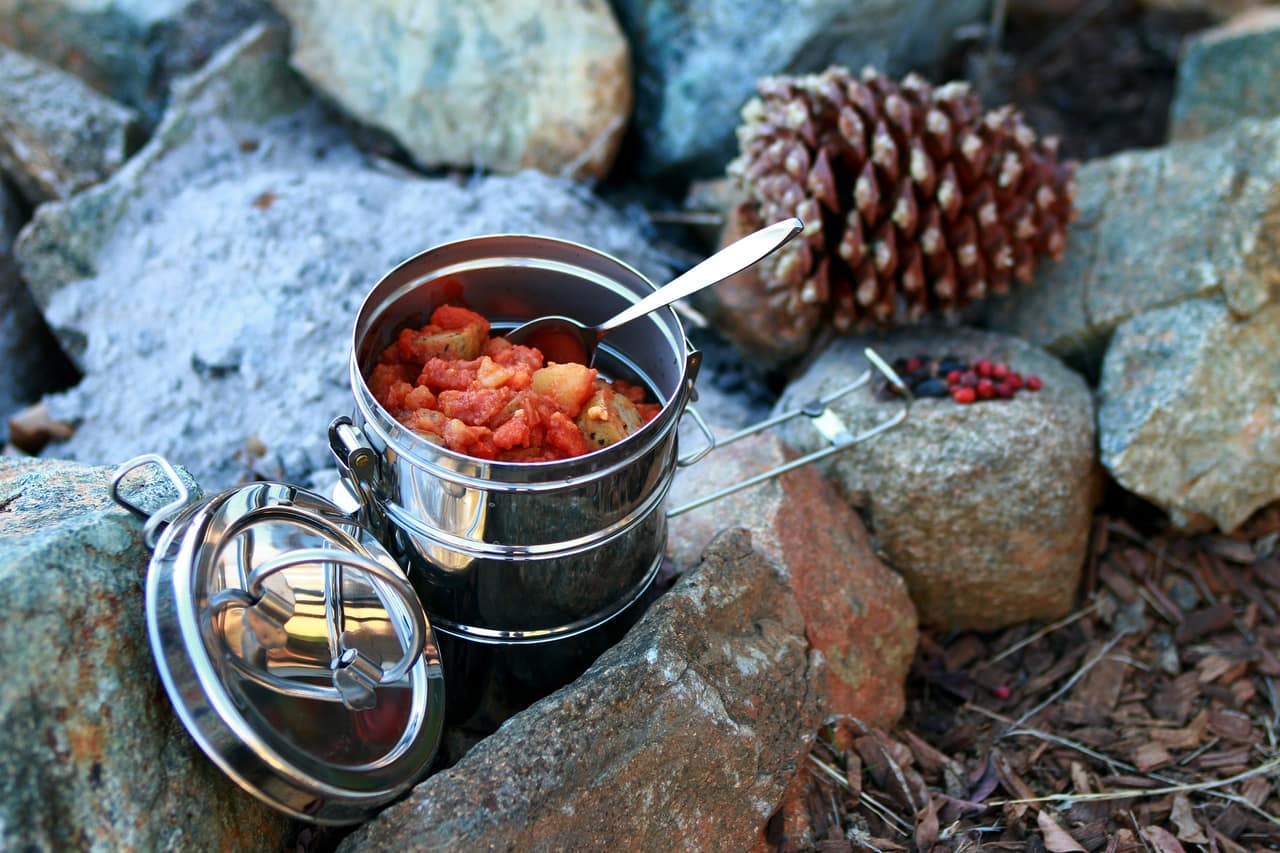
The reliable patterns: chili and stews, which improve if made at home and reheated; pasta with a sauce that goes into the same pot after the water is drained; curry over rice or couscous, where couscous needs only boiling water; grain bowls built on quick-cooking grains; and a hash of pre-chopped potatoes, onions and whatever else needs using up.

Real cooking -- when you have time and a good pan

If you want to actually cook, two things make the difference. Use a thick pan -- cast iron -- because camp stove burners concentrate heat into a small ring and thin pans scorch the middle of everything. And use a stove with a usable simmer, which most budget two-burners do not have.

With both, campsite breakfast becomes genuinely good: eggs, bacon, hash, pancakes. See camping cookware for the pan and camping stoves for the heat control.

Fire cooking -- check the restrictions first

Foil packets of vegetables and protein in the coals, cast iron in a fire ring, and skewers all work well. But fire restrictions across much of the western United States prohibit open flame for months of every year, and they change through the season.

Check the managing agency's current restrictions before planning any meal around a fire, and always have a stove-based alternative. A trip plan that depends on a fire is a trip plan with a single point of failure.

04 — Food safety

Keeping food safe in a cooler

The food safety rules at a campsite are the same as at home; the difference is that your refrigerator is a box of melting ice and you do not have a thermometer in it unless you bring one.

  • Keep cold food at or below 40°F. A cheap fridge thermometer in the cooler is the only way to know rather than guess, and it costs almost nothing.
  • Raw meat goes in sealed containers at the bottom, where it is coldest and cannot drip onto anything.
  • Two coolers if you can: food and drinks. The drinks cooler gets opened constantly; the food cooler should barely be opened at all. This is the one case where a second cooler is justified.
  • Do not drain the meltwater if food is in sealed containers. Cold water holds cold better than the air that would replace it.
  • When in doubt, throw it out. Food poisoning at a campsite, far from facilities, is considerably worse than food poisoning at home.
  • Pack out all food waste. Including scraps and strained greywater solids -- both attract wildlife and both are your responsibility.

05 — Cleanup

Washing up without a sink

The three-stage system is what organized campsites use, and it genuinely works better than improvising with one bowl.

  1. 01Scrape first, into the trash. Food solids in your wash water make every subsequent step worse, and they must be packed out anyway.
  2. 02Wash in hot water with biodegradable soap, in a collapsible sink or wash bag. Heat a pot of water while you eat so it is ready.
  3. 03Rinse in a second container of clean water. This is the stage people skip, and it is why camp dishes taste of soap.
  4. 04Strain the greywater, pack out the solids, and scatter the water widely at least 200 feet from any lake, stream or spring, and away from camp.
  5. 05Air dry. A towel at a campsite is a bacteria transfer system. Hang things on a line instead.

What to buy

The gear we would buy for this

Trail & Terminal earns a commission when you buy through our Amazon links, at no extra cost to you. It does not change which products we pick -- see our affiliate disclosure and selection method.

1

Best for anything you actually cook

Lodge 10.25 Inch Cast Iron Skillet

The thermal mass that stops camp stoves scorching the middle of your food.

If camp breakfasts matter to you, this is the single most valuable purchase. Camp burners concentrate heat and thin pans transmit it straight through; cast iron spreads it. More in <a href="/camp/best-camping-cookware">camping cookware</a>.

Specs

  • Pre-seasoned cast iron
  • Thick base that evens out burner heat
  • Usable in coals and on a fire grate
  • Effectively unlimited service life

Good for

  • Solves the hot-spot problem that ruins food in thin camp pans
  • Works on a stove, a grate or in coals
  • Nothing you do with utensils or scrubbing can damage it

Bad at

  • Heavy and does not nest
  • Rusts if packed away damp
  • Slow to heat on a small canister stove
2

Best for cooking rather than boiling

Camp Chef Everest 2X

The stove with a genuine low setting, which is what separates cooking from heating.

Sauces, eggs and anything that can catch need a low flame, and most budget stoves do not have one. This is the upgrade that makes camp cooking rather than camp heating possible. See <a href="/camp/best-camping-stoves">camping stoves</a>.

Specs

  • Two high-output burners
  • Push-button ignition on both
  • Three-sided wind screen
  • Standard 1lb propane, bulk tank adapter available

Good for

  • Controls genuinely simmer, unlike entry-level stoves
  • Ignition means no matches in wind
  • High output boils noticeably faster

Bad at

  • Several times the price of a basic two-burner
  • Heavier and taller packed
  • Piezo igniters are the eventual failure point
3

Best for trips where food safety matters

RTIC 52 QT Hard Cooler

If your food has to stay below 40 degrees for several days, thick walls and a gasket are the only way.

For trips past two nights with raw meat and dairy involved, retention becomes a food safety question rather than a convenience one. Put a thermometer in it. Tiers compared in <a href="/camp/best-coolers-for-camping">camping coolers</a>.

Specs

  • Rotomolded with pressure-injected insulation
  • Full-length freezer gasket
  • Heavy-duty T-latches
  • Integrated drain plug

Good for

  • Multi-day retention that budget coolers cannot reach
  • Cheaper than comparably specified competitors
  • Thick walls and a real gasket -- what actually holds ice

Bad at

  • Very heavy loaded
  • Much larger outside than in
  • Latches are the common failure point

Questions

Frequently asked

What are the easiest camping meals?
No-cook meals for the first night -- sandwiches, wraps, cold grain salads, boards -- and one-pot meals after that. A chili or stew made at home and reheated at camp is the easiest hot dinner there is, and it dirties exactly one pot.
What camping food does not need refrigeration?
Hard cheeses, cured meats, tinned fish, nut butters, tortillas and bread, dried fruit and nuts, instant grains and oats, pasta and sauces in jars, and anything freeze-dried. A meal plan built mostly on these reduces how much your cooler has to do.
How do I keep food cold while camping?
Pre-chill the cooler overnight, use block ice with cubes to fill gaps, aim for two parts ice to one part contents, keep it shut and in shade, and put a cheap thermometer inside so you know it is below 40 degrees. Those habits matter more than which cooler you own.
How do you wash dishes while camping?
Scrape into the trash, wash in hot soapy water in a collapsible sink, rinse in a second container of clean water, then strain the greywater, pack out the solids, and scatter the water at least 200 feet from any water source and away from camp. Air dry rather than towel dry.
Can I cook over a campfire?
Where it is permitted, yes -- foil packets, cast iron and skewers all work well. But fire restrictions prohibit open flame across much of the western United States for months each year and change through the season, so check the current rules for your destination and always have a stove-based alternative.

Back up a level

This page sits in Camp -- campsite kit: shelter, sleep, kitchen, light and power.

Read next